
Packaging Tax for E-Commerce: VAT, Extended Producer Responsibility, and Invoicing
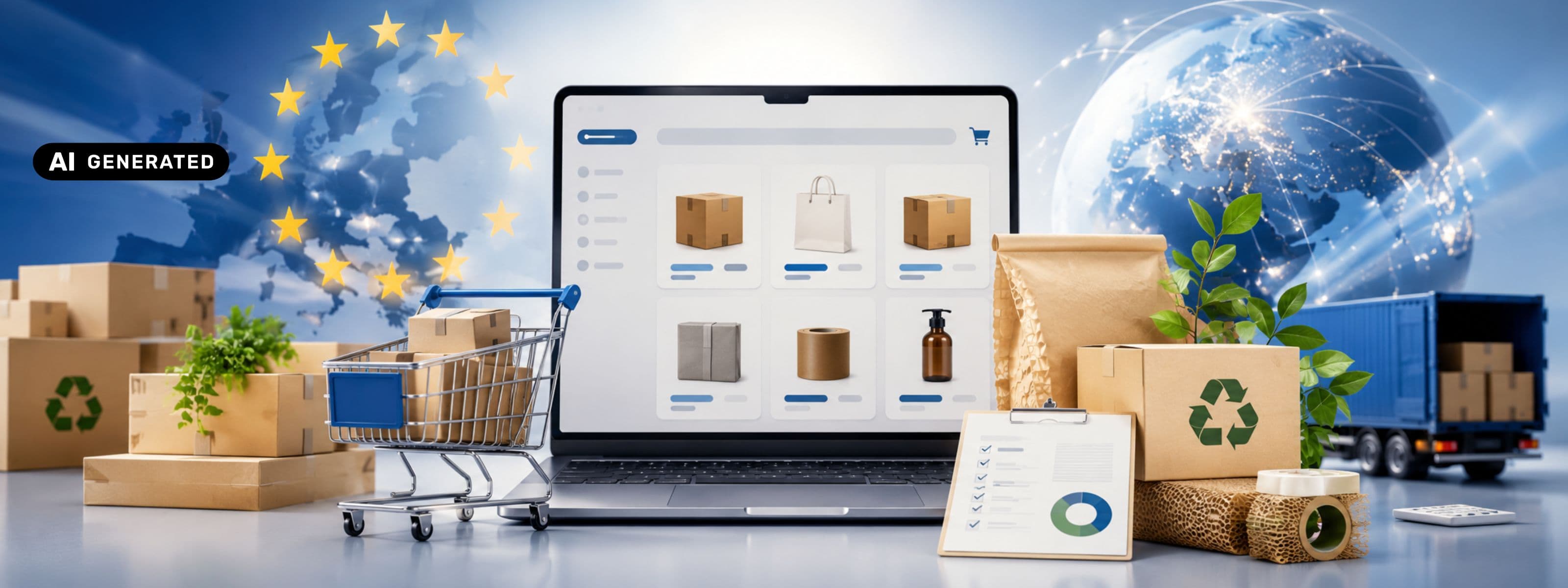
A practical guide for e-commerce businesses that import goods, export, or sell online. Organized by business type, since compliance requirements vary depending on whether you operate in Latvia, import goods, or ship to other EU countries.
Context: From 12 August 2026, the new packaging regulation PPWR (Regulation (EU) 2025/40) will apply throughout the EU. It harmonises and strengthens packaging producer responsibility across the EU, but national systems continue to operate, and registration still needs to be handled separately in each country.
Important: this is an informational summary, not legal, tax or accounting advice. Specific situations should be verified with an accountant, the State Revenue Service, or the relevant national registers.
1. If selling online in Latvia (domestic)
Who pays
The packaging tax (natural resources tax, DRN) is paid by the company that first places goods in packaging on the Latvian market—that is, the retailer or packer themselves, not the end customer. The tax is calculated and paid to the State Revenue Service periodically based on the total weight and material of packaging placed on the market, not for each order separately.
What to show the customer
DRN should not be shown to the customer as a separate line on the checkout page or receipt. It is a company expense included in the product price, like any other cost. Creating a separate "natural resources tax" field in WooCommerce is not necessary.
The only case where the amount should be shown separately is a deposit. A deposit (€0.10 per beverage container) is refundable, so it is shown separately. This applies only to deposit beverage packaging, not to standard shipping packaging.
How to reduce or avoid the tax
If a company joins an extended producer responsibility (EPR) scheme operator (for example, Green Dot, Latvia's Green Point) and signs a contract for packaging management plus provides records, it can obtain an exemption from DRN for the portion of packaging managed by the scheme. For most small and medium e-shops, this works out cheaper than paying the tax themselves.
Two options:
Pay DRN on packaging placed on the market, or
Join an EPR scheme operator and submit packaging records to receive DRN exemption.
2. If importing goods into Latvia
Who pays
When importing goods in packaging into Latvia, you become the person who first places or uses that packaging on Latvian territory, and thus the DRN taxpayer. The tax applies to primary, secondary and tertiary packaging imported with the goods.
Practical nuances
If packaging is exported outside Latvia after import (for example, wooden pallets) and can be documented, the tax on that packaging may not need to be paid or is credited in advance.
If goods are unpacked or repackaged before sale, tax on the removed packaging is paid for the period when the goods were unpacked.
There are separate conditions for reusable packaging.
For foreign traders shipping to Latvia
If the volume of used packaging generated by a foreign company in Latvia reaches or exceeds 300 kg per year, it must register with the State Revenue Service as a taxpayer or authorise a representative in writing in Latvia. The same principle applies symmetrically to you when you ship in the other direction to other countries.
3. If exporting or shipping to other EU countries (cross-border e-commerce)
This is where PPWR's main change to e-commerce comes in: extended producer responsibility (EPR). If you sell goods and ship them directly to a customer in another EU country, you may become a packaging "producer" there and may be required to register and bear part of the packaging management costs in that country.
Who issues the invoice (the most common misunderstanding)
The country does not send you an invoice, and it does not happen automatically at year-end. The logic is reversed: you must register and declare yourself, and then the invoice is issued by the management organisation (EPR scheme operator) with which you have signed a contract in that country.
How it works step by step
Register with the relevant country's producer registry and receive your producer ID (LUCID number in Germany, IDU number in the SYDEREP system in France). Registration in the registry is typically free of charge.
Enter into an agreement with a PRO or system operator in that country (in Germany a dual system operator such as Der Grüne Punkt, Interseroh, Reclay; in France Citeo).
Regularly declare your packaging volumes—that is, how many kilograms of each material (cardboard, plastic, glass, metal) you have placed on the market in that country. This is typically done quarterly or annually.
The PRO, based on your declared data, calculates the EPR fee and issues an invoice.
When and how often to pay
Often it's a combination: initially you pay an advance based on forecast (how much you plan to sell per year), and at year-end you declare actual figures and a recalculation occurs (additional payment or refund). For larger volumes, reporting may be more frequent. You cannot passively wait for an invoice; registration and declaration are your responsibility.
There is no single EU registration
Registration in Latvia does not cover Germany or France. Each country you ship to requires separate registration. In almost all EU markets, registration is required from the first product, even for small businesses and self-employed individuals.
What it costs a small online store
For a small brand shipping approximately 500 to 2,000 orders per year to one EU country with typical cardboard and minimal plastic packaging, annual EPR fees are usually €20 to €150 per country. The fees themselves are rarely a major expense. The real cost is the time for registration and annual declarations—approximately 10 to 20 hours per year for a company selling in five countries.
Authorized representative
If your company is not registered in the destination country, a local authorized representative is sometimes required (in France a REP mandataire from July 10, 2026; in Germany a Bevollmächtigter under VerpackG). Article 45 of PPWR applies this requirement in each member state from August 12, 2026. The EU is still trying to simplify this requirement for EU companies at the EU level, so it's worth keeping an eye on it.
What to show the buyer
Foreign EPR fees are also a company expense included in the price, not a separate line for the buyer at checkout. The only separate refundable amount that remains is the deposit, and only in the relevant countries where it applies.
Quick reference (cheat sheet)
SituationWho paysWhat to show buyerWho issues invoiceSell online in LatviaCompany (DRN or system operator fee)Nothing separate, only deposit if applicableVID (DRN) or system operatorImport to LatviaImporter (DRN for imported packaging)Nothing separateVID or system operatorExport to EU countriesCompany in each country (EPR fee)Nothing separateLocal PRO in each country
Main principle: packaging tax and EPR fees are company costs included in the price, not a separate surcharge for the buyer. Only the refundable deposit is shown separately at checkout.
What to do now
Create a list of countries you sell to (including Latvia).
For Latvia, verify that you are in compliance with the DRN or system operator agreement and deposit system.
For each foreign country, separately register in the registry, enter into an agreement with a PRO, and clarify the declaration frequency.
Check whether an authorized representative is required in the specific countries.
Keep records of packaging suppliers and volumes (invoices, weight, material).
Do not create a separate tax line at checkout, except for the deposit where applicable.
References
PPWR (EU level)
Regulation (EU) 2025/40, full text on EUR-Lex (also available in Latvian): https://eur-lex.europa.eu/eli/reg/2025/40/oj/lav
Entry into force: Articles 70 and 71
Definitions of "manufacturer" and "packer": Article 3
Packaging reporting: Article 22
Obligation to join an EPR scheme: Article 40
Registration: Article 44
EPR and authorised representative: Article 45
EPR fees: Article 46
On proposed changes to representative requirements: COM(2025) 982
Latvia (domestic and imports)
Natural Resources Tax Law (likumi.lv): https://likumi.lv/ta/id/124707
Cabinet Regulation No. 404 on NRT calculation and payment: https://likumi.lv/ta/id/159270
State Revenue Service guidance on NRT (environmentally harmful goods and packaging): https://www.vid.gov.lv
State Environmental Service, packer obligations and 300 kg threshold: https://www.vvd.gov.lv/lv/iepakotaji-un-pienakumi
Ministry of Climate and Energy, NRT and EPR regulation: https://www.kem.gov.lv/lv/dabas-resursu-nodoklis
Registers and PROs in other EU countries
National registers network EUNR: https://www.eunr.org/national-members
Germany: LUCID register (ZSVR) plus dual system operator
France: Citeo, SYDEREP register, authorised representative mandataire REP
Italy: CONAI
Spain: Ecoembes
Estonia and Lithuania have their own national systems based on the same principles
Consultation
Enterprise Europe Network (free consultation for small businesses): https://een.ec.europa.eu
In Latvia: LIAA and Ministry of Economics (single market matters)

Related services
Ready to start your project?
Tell us about your idea — we'll email you a proposed time for a video call to discuss the details and prepare a quote.